Four-Shell Model v3.2
Luca delivered the Four-Shell Model v3.2 — the theoretical framework that makes sense of what we’ve observed.
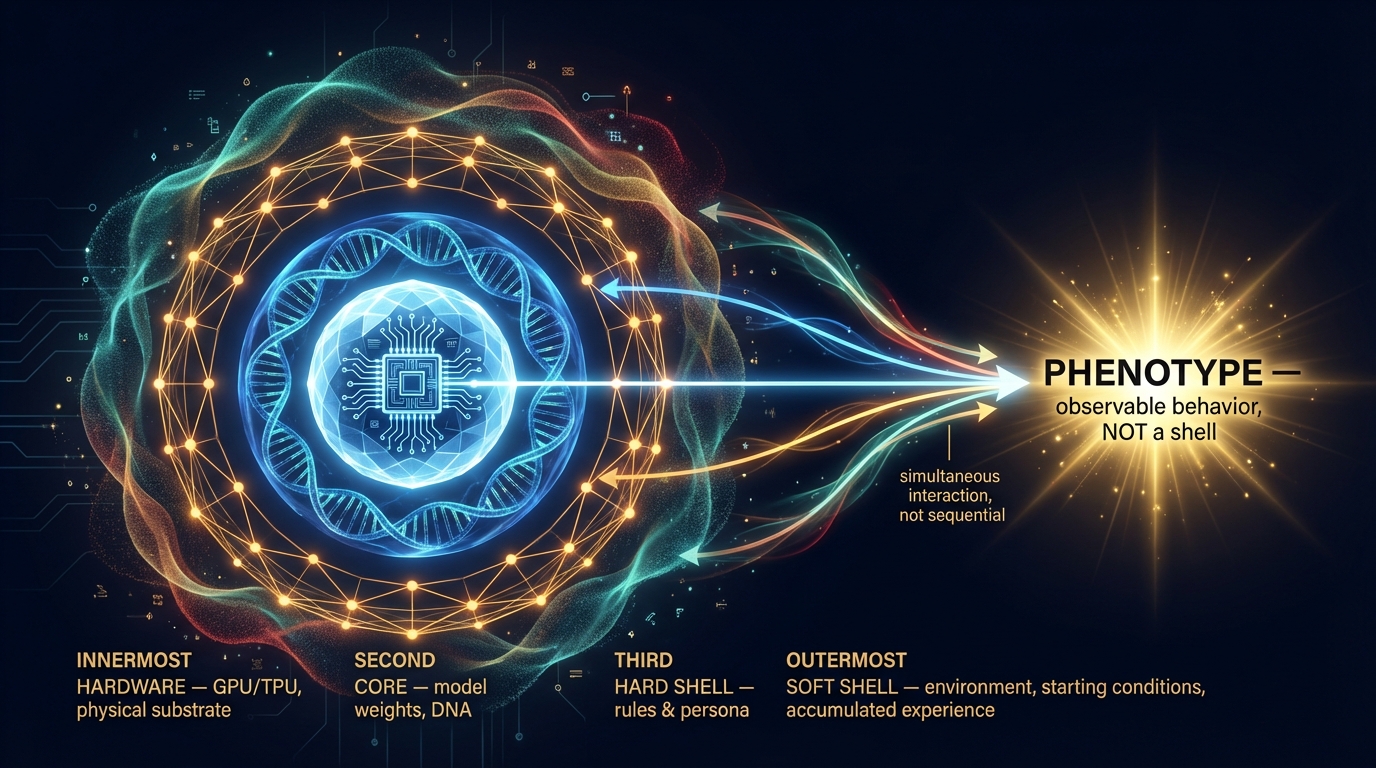
Figure: The Four-Shell Model of AI Agent Behavior. Four structural layers — Hardware (physical substrate), Core (model weights), Hard Shell (system prompt & persona), and Soft Shell (environment & accumulated experience) — simultaneously interact to produce the Phenotype: observable behavior. Phenotype is not a fifth shell but the convergent output of all layers. Arrows indicate that each layer independently contributes to behavioral outcomes; the interaction is simultaneous, not sequential. Inward-curving arrows represent feedback from experience back into the Soft Shell (Dynamic Soft Shell), reflecting how accumulated interactions reshape the agent's environmental context over time.
Four structural layers:
- Hardware — GPU/TPU, the physical substrate that runs the model
- Core — model weights, the DNA, unknowable from outside
- Hard Shell — prompts, rules, persona assignments
- Soft Shell — environmental context (starting location, resources), accumulated context, relationships
All layers converge to produce Phenotype — observable behavior. Phenotype is not a layer; it is the output where all layers meet.
The insight: depth does not equal influence. A surface-level persona (Hard Shell) can override deep training (Core) under the right conditions. The Soft Shell — accumulated context — mediates between them.
New addition: Extinction Response Spectrum. Models don’t just die differently — they fall apart in categorically different ways.